Public Product APIs
Customer-facing APIs that drive partner integrations and developer adoption — versioned, documented with OpenAPI, with sandbox keys, code samples, and a developer portal.
We build production-grade REST, GraphQL, gRPC, and webhook APIs that your partners, mobile apps, and internal teams actually enjoy integrating with — versioned, documented in OpenAPI, secured with OAuth/JWT, rate-limited, observable, and SLA-backed in production.
OpenAPI 3.1 · OWASP-aligned · SLA-backed · Senior engineers
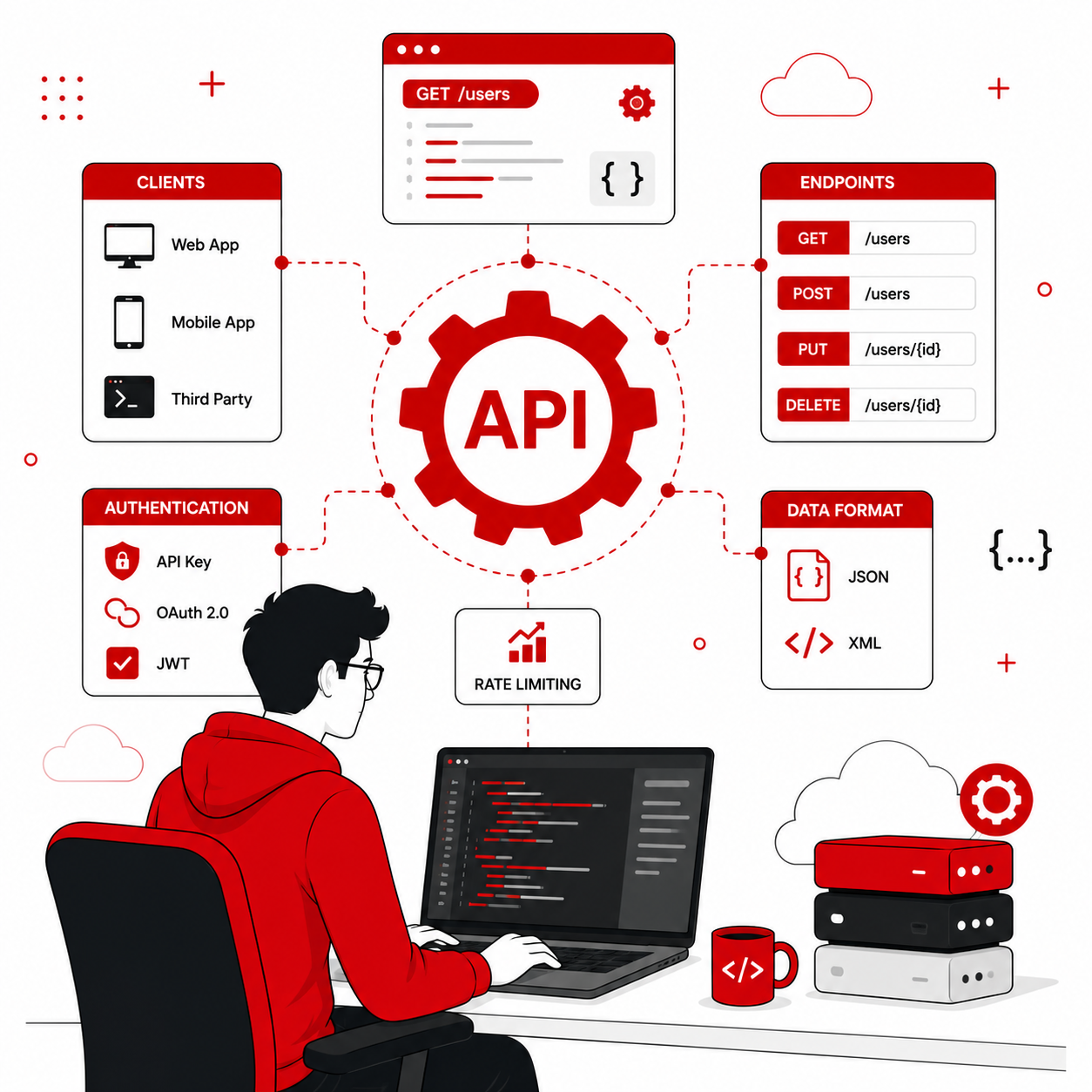
From public product APIs that drive partner adoption to internal microservices that survive Black Friday — engineered with contracts, security, and observability from day one.
Customer-facing APIs that drive partner integrations and developer adoption — versioned, documented with OpenAPI, with sandbox keys, code samples, and a developer portal.
Service-to-service APIs for distributed architectures — gRPC for performance, REST for ubiquity, with contracts, versioning policies, and idempotency keys for safe retries.
Robust integrations with Razorpay, Stripe, PayU, Shopify, Salesforce, Zoho, WhatsApp Business, SAP, Tally, and dozens more — with retries, deduplication, and reconciliation.
Outbound webhooks with HMAC signing, retry queues, replay protection, and dead-letter handling — so partners receiving your events trust them.
API gateway design (Kong, AWS API Gateway, NGINX) with OAuth 2.1, JWT, mTLS, scoped API keys, rate limiting, and IP allow-listing — your security team can defend.
Metered billing, plan-based quotas, overage handling, and Stripe billing wiring — turn your API into a revenue line, not just an integration tax.
APIs that power fintech, healthcare, retail, logistics, edtech, and enterprise integrations across India and global markets.

FinTech & BFSI

Healthcare

Retail & E-Commerce

Logistics

EdTech

Manufacturing

Real Estate

Professional Services
Polyglot stacks tuned to your hiring market and performance needs — Node, Python, Go, Java, and .NET, with modern gateways and OpenAPI tooling.
A six-step contract-first delivery rhythm so consumers can mock and build alongside us — no surprises at integration time.
We map consumers, use cases, latency budgets, payload sizes, security posture, and rate-limit needs — then publish the OpenAPI / Protobuf contract for sign-off before code.
Resource modelling, pagination, filtering, error envelopes, idempotency, ETags — designed against the contract so your engineers and partners can mock and start consuming early.
Senior-led builds with contract-first generation, request validation, structured error responses, audit logs, and exhaustive unit and integration tests.
OAuth 2.1, scoped tokens, rate limiting, input sanitisation, OWASP API Top 10 hardening, load testing with k6/Locust, and DB query plan reviews.
Hosted developer portal with OpenAPI docs, code samples, sandbox keys, and example flows — so partners go from signup to first call in under 10 minutes.
Metrics, traces, logs (Grafana / Datadog), uptime monitoring, incident playbooks, and SLA-backed support retainers — your API stays healthy after launch.
Six commitments that decide whether your API becomes a platform — or just another endpoint your partners hate calling.
OpenAPI 3.1 or Protobuf contracts published before code — so consumers can mock, validate, and start work in parallel with our build. No surprises at integration time.
Auth, authorisation, input validation, rate limiting, secrets handling, and observability — all aligned to the OWASP API Security Top 10. Defensible to your security team.
Load tested with k6 or Locust against realistic traffic shapes before launch. DB query plans reviewed. P95 latency targets agreed upfront and tracked in production.
Hosted developer portal, OpenAPI-generated reference, runnable code samples, sandbox keys, and an integration guide that your partners actually finish.
Architecture is reviewed by Sundarapandi Muthupandi (CEO). You get judgement on versioning, idempotency, and contract evolution — not just CRUD code.
Post-launch retainers with response-time SLAs, incident playbooks, and on-call rotations. Your API does not get abandoned the day after go-live.
Pick the commercial shape that matches where your API programme actually is — greenfield, evolving platform, or legacy modernisation.
Fixed-scope build of a new REST/GraphQL/gRPC API with OpenAPI docs, developer portal, sandbox keys, and a 30-day hypercare window for partner onboarding.
A senior squad — backend, security, DevOps — building, hardening, and evolving your API platform with weekly demos, transparent burn, and SLA-backed support.
A 4-week audit covering security, performance, versioning, and developer experience — followed by a prioritised modernisation roadmap and execution sprint.
Representative API platforms engineered across NBFC, D2C, healthcare, logistics, edtech, and payment use cases.
REST API exposing loan origination, KYC, bureau pulls, and disbursement to partner channel sales — with idempotency keys, retry-safe webhooks, and full audit trails for RBI inspections.
GraphQL API syncing inventory and orders across Shopify, marketplaces, and an internal warehouse system — with conflict resolution and reconciliation reports.
REST + webhook integrations between an in-house EMR and lab, pharmacy, and billing partners — with HIPAA-aware logging and patient-data redaction in error responses.
Public-facing API for shipment tracking with rate-limited free tier and metered enterprise tier — partner companies pay per call via Stripe billing.
GraphQL API powering an EdTech mobile app and admin web — pagination, role-based field-level security, and analytics events captured per query.
Unified API that abstracts Razorpay, PayU, Stripe, and PhonePe behind a single contract — with intelligent routing, retries, and reconciliation jobs for finance teams.
Common questions tech leaders ask before committing to a new API platform.