Manufacturing & Shop-Floor Apps
Operator terminals that capture production data, downtime codes, scrap reasons, and maintenance triggers — queueing locally when WAN is patchy and reconciling without duplicate postings when it returns.
From shop-floor terminals and diagnostic workstations to financial trading consoles and creative tools — we engineer installer-driven desktop applications that work offline, integrate with hardware, and survive the realities of enterprise IT rollouts.
Offline-first · Signed installers · SCCM/Intune ready · Senior engineers only
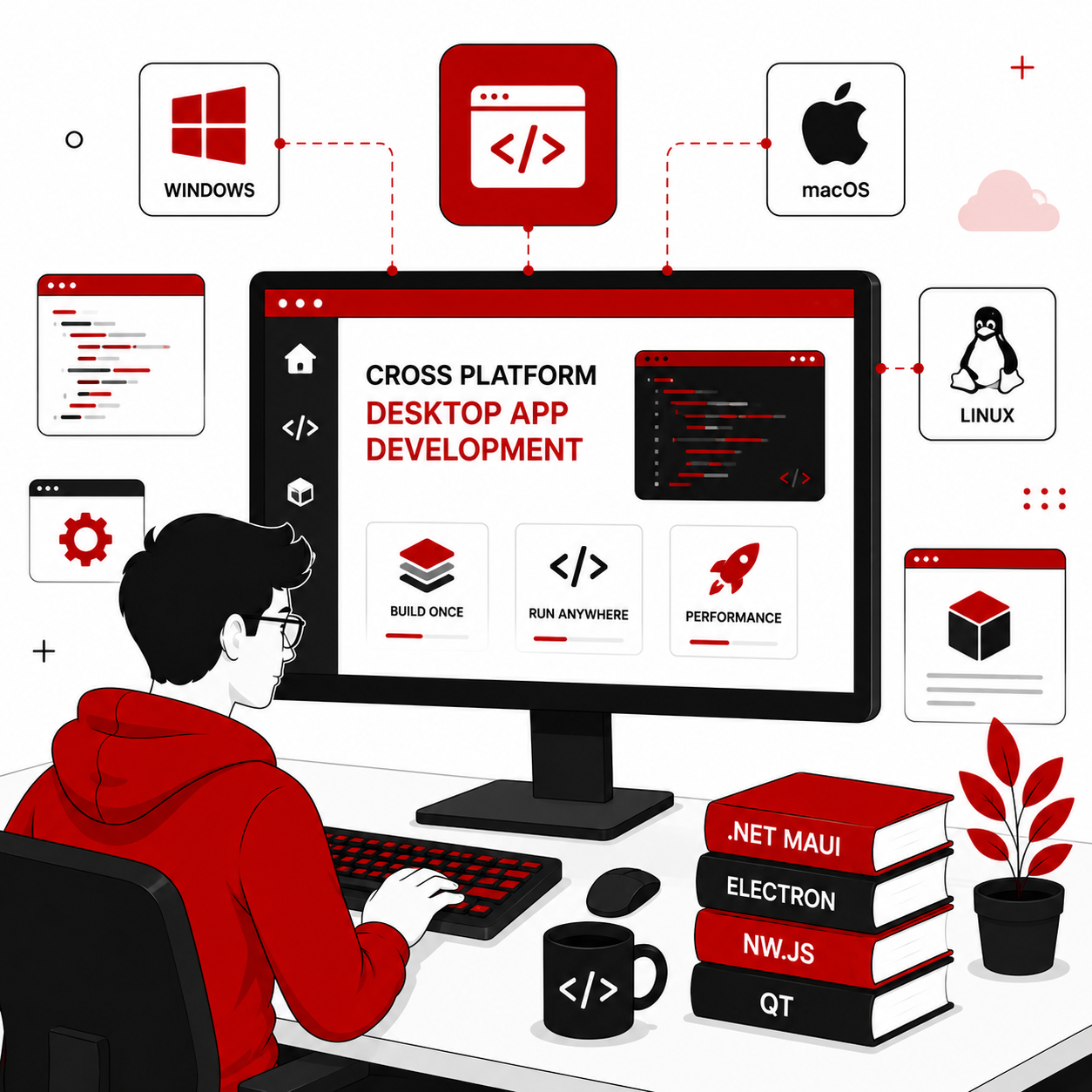
From operator terminals on production lines to analyst consoles in trading rooms — desktop applications engineered for the specific hardware, network, and compliance realities of your environment.
Operator terminals that capture production data, downtime codes, scrap reasons, and maintenance triggers — queueing locally when WAN is patchy and reconciling without duplicate postings when it returns.
Instrument-connected desktop software with structured audit logs, accreditation-ready reporting, and strict data residency — designed for clinical, pharma, and research environments.
Offline-first POS, stock receipts, transfers, and head-office approvals that survive nightly sync windows across tier-2 and tier-3 store connectivity.
Low-latency dashboards, risk monitors, and approval consoles for treasury, NBFC, and broker-dealer teams — where milliseconds and audit trails both matter.
Niche professional tools — design utilities, file processors, schedulers, and bespoke editors — engineered for performance on the hardware your users actually run.
Admin consoles, batch processors, technician workstations, and field-service desktop apps that replace fragile macros and shared spreadsheets with reliable, signed software.
Desktop applications shaped to industry workflows — from regulated environments where data residency is non-negotiable to field operations where connectivity is unpredictable.

Manufacturing

Retail & POS

Logistics

Healthcare

BFSI

Pharmaceuticals

Education

Professional Services
Modern desktop frameworks for cross-platform reach, plus native toolchains where performance, hardware access, or UI fidelity matter most.
A six-step delivery rhythm engineered so IT operations, security, and end users all stay aligned — from first hardware audit to long-term evergreen care.
We map operator workflows, hardware integrations (scanners, scales, instruments), OS estate, MDM tooling, and licensing posture before recommending a stack — Electron vs .NET vs Qt vs native.
Wireframes, accessibility checks (keyboard-first navigation), localisation hooks, plus a packaging spike — MSI/MSIX, signed installers, and silent-deploy manifests for SCCM, Intune, or JAMF.
Milestone releases pushed to pilot sites with real users — offline-queue testing, hardware bring-up, telemetry sanity, and bug-bash windows after every drop.
Code signing custody, SBOM snippets, vulnerability scanning, Chromium/runtime bumps, CSP-like hardening, and full SCCM/Intune packaging QA against your golden images.
Wave-based deployment, training collateral, command-centre dashboards for adoption KPIs, and an on-call hypercare desk during the first 30 days of national go-live.
OS upgrade tracking (Windows 11 cycles, macOS releases), dependency CVE response, feature deltas, and predictable monthly retainers — your IT team is never surprised.
Six commitments that decide whether you ship a desktop application your IT team can deploy — or one they will quietly refuse to roll out.
Architectural decisions are reviewed by Sundarapandi Muthupandi — CEO & Senior Developer. The engineers who scope your project are the ones who actually ship it.
Not just UX. Packaging, WSUS/Intune realities, crash budgets, signing custody, and rollback rings are scoped from day one — not bolted on after the first failed rollout.
Operators never lose a shift's worth of captures. Background queues, conflict resolution, and resilient sync are engineered in, not added as an afterthought.
Encrypted local stores, OS credential vaulting, configurable retention, PII-scrubbed crash analytics, and the artefacts your vendor onboarding pack asks for.
Electron vs .NET vs Qt vs native — documented trade-offs, not religion. We pick what fits your hiring market, licence posture, and 5-year roadmap.
Indian engineering rates from our Chennai and Bengaluru offices delivered to enterprise standards — predictable burn, transparent SOWs, and direct access to the developers writing your code.
Pick the commercial shape that matches where your desktop programme actually is — a pilot, a national rollout, or long-term evergreen care.
A fixed footprint on selected sites with acceptance tied to real throughput metrics, hardware bring-up, and IT packaging sign-off — before any national rollout commits.
Wave-based deployment across stores, plants, or branches — with training collateral, adoption dashboards, and command-centre support during the cutover window.
Predictable monthly burn covering OS upgrade cycles (Windows 11, macOS releases), dependency CVEs, feature deltas, and SLA-backed incident response.
Representative desktop applications we have engineered across manufacturing, BFSI, healthcare, retail, and field operations.
Operator terminals across Tamil Nadu plants capturing yield, downtime codes, and maintenance triggers — syncing when VPN returns without duplicate postings or lost shifts.
Instrument-connected workflows in diagnostic labs with structured audit logs suitable for NABL accreditation surveys — patient data residency stays under your roof.
Stock transfers and HO approvals across tier-2 and tier-3 store connectivity — surviving nightly sync windows without losing intra-day cash receipts.
Loan-officer desktop apps with offline KYC capture, document scanning, and end-of-day reconciliation that meets RBI inspection trail requirements.
Batch release workstations integrating with HPLC and titration instruments — with 21 CFR Part 11-aware audit trails and signed electronic records.
Service-engineer laptops with offline manuals, parts catalogues, and ticket sync — engineered for site visits where 4G is unreliable but uptime expectations are not.
Common questions IT teams and business owners ask before scoping a desktop application project.