Transactional Email Servers
High-throughput SMTP relay servers for OTP, password reset, receipts, invoices — with REST APIs, webhook callbacks, suppression lists, and per-tenant rate limiting.
We design, deploy, and operate private email infrastructure — self-hosted SMTP relay servers, full IMAP/JMAP mailbox platforms, transactional email APIs, and admin consoles — with DKIM, SPF, DMARC, MTA-STS, TLS-RPT, and deliverability tuning that keeps your mail out of spam folders and inside your perimeter.
DKIM · SPF · DMARC · MTA-STS · TLS 1.3 · IP warming
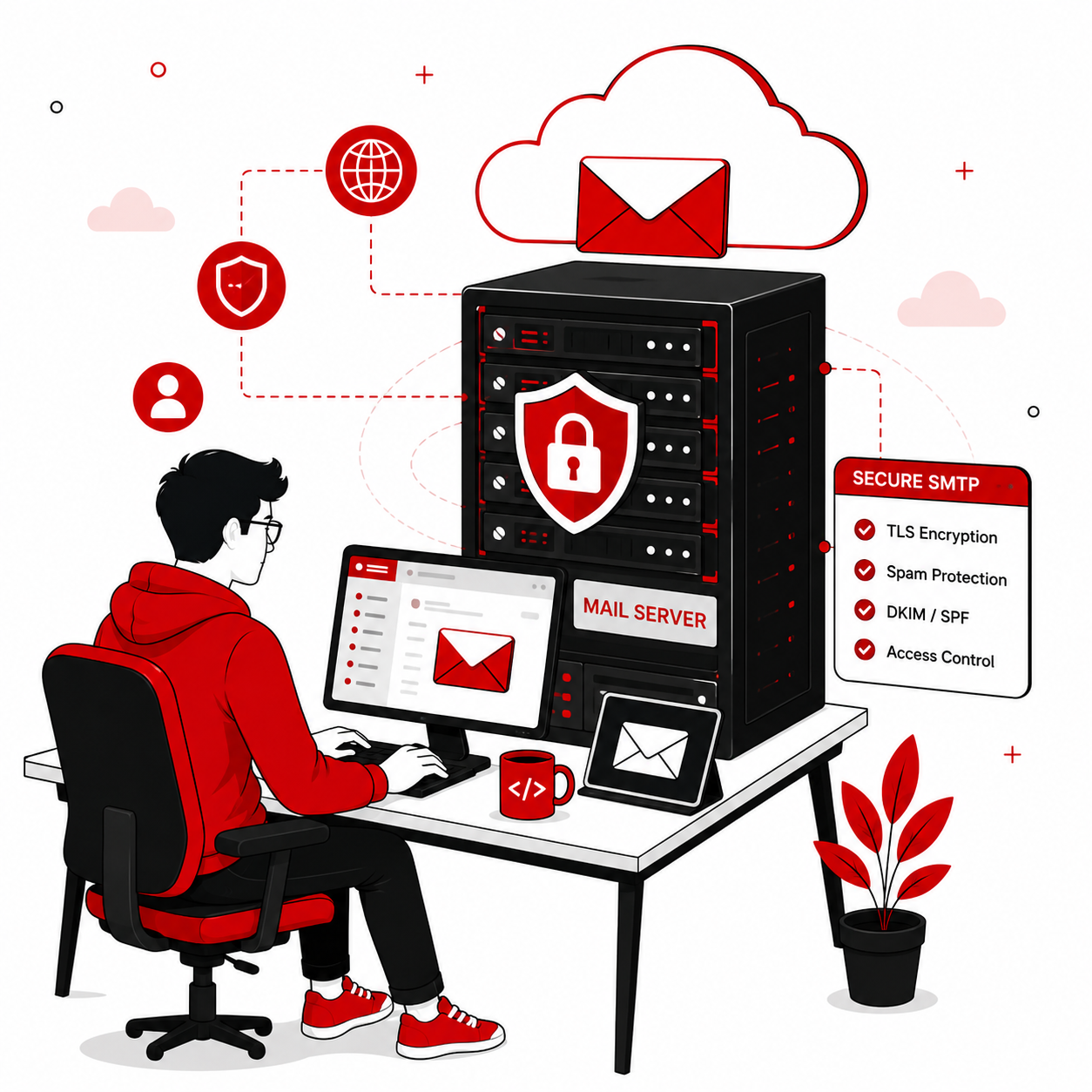
From high-throughput transactional relays to full IMAP/JMAP mailbox platforms — engineered for deliverability, sovereignty, and security.
High-throughput SMTP relay servers for OTP, password reset, receipts, invoices — with REST APIs, webhook callbacks, suppression lists, and per-tenant rate limiting.
Dedicated marketing mail infrastructure — IP warming, segmentation, bounce processing, complaint feedback loops, and unsubscribe automation aligned to RFC 8058 and CAN-SPAM.
Self-hosted IMAP and JMAP mailbox platforms — user management, quotas, sieve filtering, calendars, contacts, and webmail (Roundcube, SOGo, JMAP clients) for enterprise email sovereignty.
DKIM, SPF, DMARC, MTA-STS, TLS-RPT, BIMI setup; warming new IPs; postmaster outreach; deliverability monitoring — so your emails reach the inbox, not the spam folder.
Rspamd or SpamAssassin integration, Bayes training, RBL/DNSWL lookups, ARC sealing for forwards, ClamAV scanning, and DMARC-aligned anti-phishing on inbound flows.
Bespoke admin consoles for user provisioning, sending stats, bounce reports, deliverability dashboards, and webhook subscriptions — your ops team can run it without SSH access.
Mail infrastructure for BFSI, healthcare, government, education, and enterprises where email sovereignty is a strategic requirement.

FinTech & BFSI

Healthcare

Retail & E-Commerce

EdTech
Logistics

Real Estate

Manufacturing

Professional Services
Battle-tested open-source MTAs, IMAP/JMAP servers, anti-spam, and signing tools — selected per scale, residency, and operations posture.
A six-step rhythm engineered so your mail reaches inboxes from day one — not after months of reputation repair.
We profile your volumes, residency requirements, sender reputation, and existing DNS — and document the architecture (relay vs full mailbox, single vs multi-region, IP planning).
Server layout, MX records, DKIM/SPF/DMARC policy roadmap, MTA-STS, TLS-RPT, firewall design, and disaster-recovery plan — written up for sign-off before any provisioning.
Provisioned on your cloud (AWS, Azure, GCP, Hetzner) or on-prem; full stack deployed via Ansible/Terraform; encrypted volumes; firewall rules; backup pipelines from day one.
TLS 1.3, opportunistic DANE, MTA-STS, DKIM rotation, DMARC reporting setup, IP warming if needed, postmaster registration, and inbox testing with Gmail/Outlook/Yahoo.
A bespoke admin console for user provisioning, sending stats, bounces, and deliverability dashboards; REST APIs and webhooks for application integration.
Monitoring on queue depths, deferred mails, blacklist status, TLS errors, and DMARC failures; on-call rotation; quarterly deliverability reviews; CVE response.
Six commitments that decide whether self-hosted mail becomes a strategic asset — or a deliverability disaster.
Your servers, your IPs, your data, your DNS — not a SaaS provider with seat-based pricing and unclear data-residency. Particularly valuable for BFSI, healthcare, and government workloads.
DKIM, SPF, DMARC, MTA-STS, TLS-RPT, BIMI, ARC sealing, IP warming, and postmaster outreach — we treat inbox placement as the actual product, not a side effect.
For high-volume sending or large mailbox estates, self-hosting often pays back within 6-12 months versus Mailgun, SendGrid, Postmark, or hosted Microsoft 365 seats.
TLS 1.3, DANE where possible, strict DMARC policies, anti-phishing on inbound, malware scanning, and full audit logs — built for security teams that need to actually approve.
Mail is a deceptively complex domain — small misconfigurations cause large reputation damage. Our engineers have shipped and operated production mail platforms for years.
We can hand over fully to your team with runbooks and training, or operate the platform under a retainer with SLAs. Your choice — no lock-in either way.
Pick the shape that matches whether you need transactional setup, a full mailbox platform, or long-term mail operations.
Fixed-scope deployment of a transactional SMTP relay with REST API, webhooks, suppression lists, DKIM/SPF/DMARC, and a basic admin console — typically 3-5 weeks.
Deploy a full IMAP/JMAP mailbox platform with webmail, calendars, contacts, anti-spam, anti-virus, deliverability hardening, and an admin console — for enterprise email sovereignty.
Predictable monthly retainer covering monitoring, deliverability reviews, IP warming, CVE response, DMARC alignment, and on-call incident response for production mail.
Representative private mail deployments across NBFC, hospital, D2C, government, edtech, and logistics use cases.
Dedicated transactional mail relay for an NBFC sending statements, OTPs, and loan notifications — with strict DMARC, encrypted attachments, and full audit logs for RBI inspections.
Self-hosted IMAP and SMTP for a hospital chain — patient discharge summaries, reports, and clinician mail kept inside the hospital's data perimeter with HIPAA-aligned logging.
Two separate mail infrastructures for a D2C brand — transactional on warmed IPs for OTP and order receipts, marketing on a different IP pool tuned for promotional campaigns.
Full on-prem mailbox platform for a state government department — air-gapped from the public internet for sensitive correspondence, with relay to public networks via a controlled bridge.
Self-hosted mail platform for an EdTech sending lakhs of parent communications monthly — engagement tracking, suppression management, and granular per-school sending stats.
Proof-of-delivery email service for a logistics platform — with DKIM-signed delivery confirmations, attachment support, and webhook callbacks back into their tracking app.
Common questions IT leaders and security teams ask before adopting a private mail platform.