Custom Rigid-Body Engines
Bespoke rigid-body simulators with position-based or impulse-based solvers tuned to your accuracy and stability requirements — far past what generic engines offer.
We engineer custom 2D physics engines, collision detection systems, constraint solvers, and deterministic simulation runtimes for games, interactive education, robotics, biomechanics, and bespoke simulators — when Box2D, Chipmunk, or Matter.js do not fit your accuracy, determinism, or footprint requirements.
Deterministic · CCD · SIMD-accelerated · WASM-ready
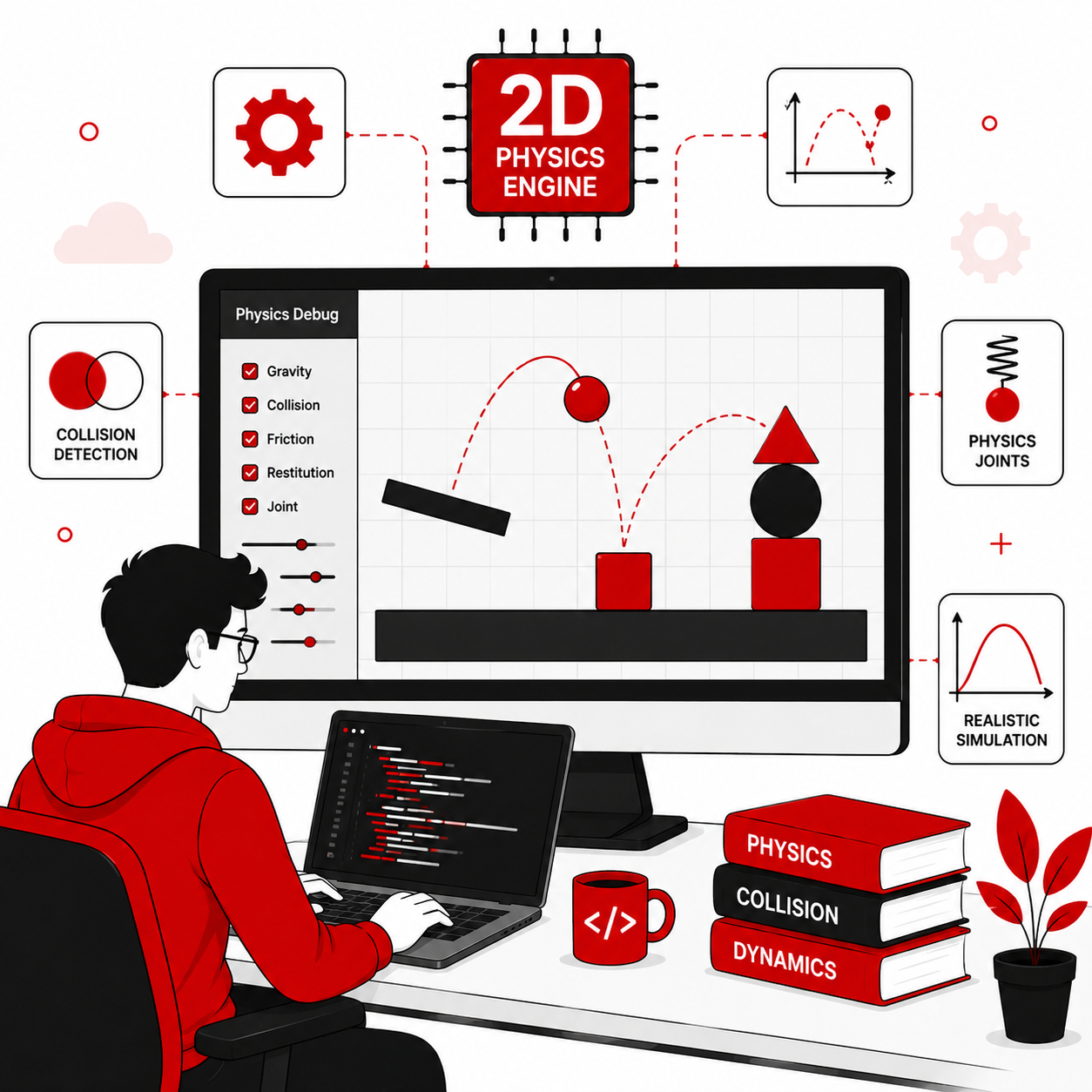
From bespoke rigid-body solvers to deterministic networked engines and soft-body simulations — engineered when off-the-shelf hits a wall.
Bespoke rigid-body simulators with position-based or impulse-based solvers tuned to your accuracy and stability requirements — far past what generic engines offer.
Custom revolute, prismatic, distance, weld, and rope constraints, plus motor constraints for vehicles, characters, and machinery — stable at large mass ratios.
SAT, GJK + EPA, AABB / SAP / dynamic BVH broadphases, continuous collision detection (CCD), and TOI calculations — pick what your scene actually needs.
Position-based dynamics (PBD), Verlet integration, mass-spring systems, and finite-element approximations for 2D cloth, rope, jelly, and fluid-ish effects.
Bindings for Unity, Godot, Phaser, PixiJS, and custom game frameworks — with editor tooling, debug renderers, and scene serialization.
Deterministic 2D simulators for robotics teaching, control-loop tuning, biomechanical research, and STEM products — reproducible runs and exportable trajectories.
EdTech, game studios, robotics, biomechanics, industrial simulation, and visualisation products — wherever physics drives the interaction.

EdTech & STEM

Robotics

Biomechanics

Game Studios

AR / Visualisation
Industrial Sim

Logistics Sim

Trading Sims
Modern systems languages, web runtimes, linear algebra libraries, and reference engines we benchmark against.
A six-step rhythm so engines ship with the stability, determinism, and performance your scene actually needs.
We map your scene scale, body counts, accuracy, determinism, platform mix, and what off-the-shelf engines fail at — before committing to a custom build.
Integration scheme (semi-implicit Euler, Verlet, RK4), solver (PGS, NGS, PBD), broadphase, and CCD strategy — designed for your accuracy/stability/footprint trade.
Engine implementation with property-based tests, stability tests on stacks and large mass ratios, determinism tests, and end-to-end perf benchmarks.
SIMD optimisation where applicable, cache-friendly layouts, fixed-point math when determinism matters, and exhaustive replay-equivalence tests.
Bindings to your game engine or web framework — Unity, Godot, Phaser, PixiJS — with debug rendering, scene serialization, and editor tooling.
Retainer for new shape types, joints, perf tuning, and ports to new platforms (mobile, WASM, console) — your engine stays alive as your product grows.
Six commitments that separate engines that ship 60fps from engines that explode on the first stack of crates.
Physics is unforgiving — small mistakes cause explosions, jitter, or non-determinism. Our engineers bring real numerical methods background, not "we tried Box2D once".
Box2D, Chipmunk2D, Matter.js, and Rapier are excellent. We will tell you when one of them fits — and when your accuracy, determinism, or footprint needs justify a custom engine.
SIMD broadphase, cache-friendly body and constraint layouts, dynamic BVH tuning, and benchmark-driven design. We aim at your real scenes, not toy demos.
Fixed-step integrators, deterministic broadphase, optional fixed-point math, and replay equivalence tests — for networked games and reproducible simulations.
Physics engines reward experience. Our seniors have shipped engines into games, EdTech simulators, and research-grade robotics workflows.
Weekly demos with debug renderers, direct access to engineers, signed SOWs with explicit accuracy and stability targets, and predictable burn.
Pick the shape that matches whether you are validating an idea, committing to production, or maintaining a shipped engine.
A 4-6 week sprint to build a focused prototype matching your scene shape, with stability tests, perf benchmarks, and a written build/buy recommendation.
Coordinated programme to design, implement, integrate, and ship a production engine with bindings, debug tooling, and tests across your target platforms.
Predictable monthly retainer covering new shapes, joints, perf tuning, platform ports, and incident response for production simulations and games.
Representative custom physics engines engineered for STEM, games, robotics, multiplayer, industrial visualisation, and biomechanics.
Custom 2D engine for an EdTech product teaching Newtonian mechanics — deterministic replays, exportable trajectories, and an authoring tool for teachers to build scenes.
Lightweight C++ engine compiled to ARM and WASM for a casual mobile/web game — 60fps on entry-level Android, with stable stacking and frictionless tuning UI.
Deterministic 2D robotics simulator for a higher-education programme — differential-drive, sensors, control-loop hooks, and Python bindings for student experiments.
Rollback-friendly fixed-step engine for a competitive multiplayer game — deterministic across platforms, with state snapshotting and replay tooling.
Bespoke 2D engine for a factory-floor visualisation product — simulates 5000+ packages on conveyors with friction, jamming, and downtime modelling.
Research-grade 2D engine for gait analysis — joint constraint solvers tuned for human-scale forces and motion capture data import.
Common questions game studios and simulation teams ask before committing to a custom physics engine.