Database MCP Servers
Secure MCP servers that expose Postgres, MySQL, MongoDB, or your data warehouse to AI agents — with read-only roles, query allow-lists, row-level security, and full audit logs.
We engineer custom Model Context Protocol (MCP) servers that connect Claude, ChatGPT, Cursor, and bespoke AI agents to your real systems — databases, internal APIs, knowledge bases, ticketing, CRMs — with the security, audit trails, and observability enterprise IT teams actually approve.
Spec-compliant · OAuth + mTLS · Audit trails · VPC / on-prem
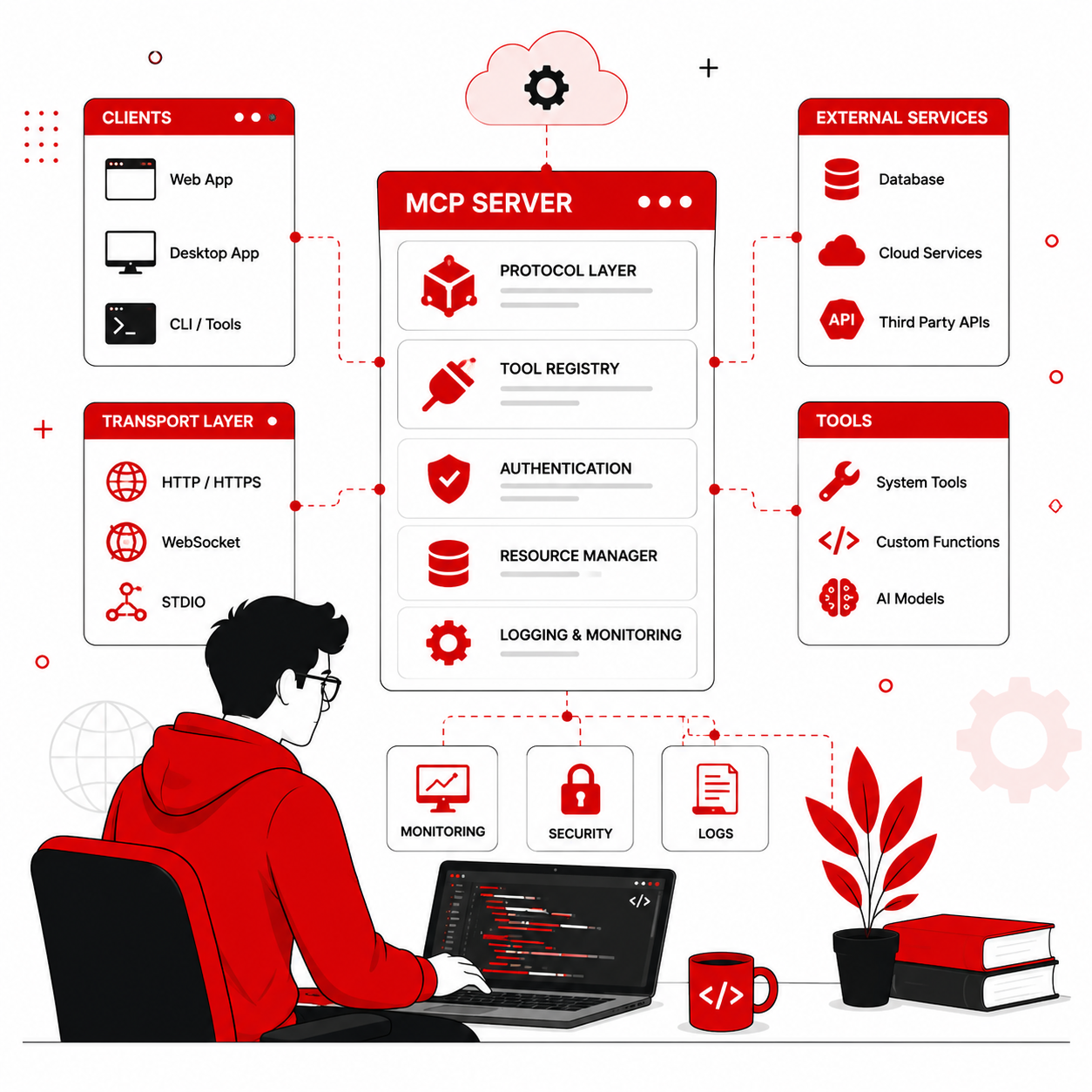
From data access servers to action-capable workflow servers — MCP integrations engineered with the security posture enterprise IT teams actually approve.
Secure MCP servers that expose Postgres, MySQL, MongoDB, or your data warehouse to AI agents — with read-only roles, query allow-lists, row-level security, and full audit logs.
MCP wrappers around Salesforce, HubSpot, Zoho, Jira, Linear, Notion, Slack, and bespoke internal APIs — so agents can read and act on your business systems through a single safe boundary.
MCP servers exposing Confluence, SharePoint, Drive, S3, or custom doc stores — with role-aware retrieval so users only see what their permissions allow.
MCP servers that let agents fire approvals, draft documents, send emails, schedule jobs, and orchestrate multi-step business workflows — with human-in-the-loop gates where it matters.
OAuth, mTLS, scoped tokens, rate limits, redaction layers, and per-tool audit logs — built for environments where your security team needs to actually approve the integration.
MCP servers exposing GitHub, GitLab, AWS, Azure, Kubernetes, observability stacks, and CI/CD pipelines — so engineering agents (Cursor, Claude Code) can ship work safely.
MCP servers shaped to the security, audit, and data-residency requirements of regulated and high-trust industries.

FinTech

Healthcare

Retail

EdTech

Logistics

Manufacturing

Professional Services

Real Estate
Official Anthropic MCP SDKs in TypeScript and Python, with battle-tested auth, transport, and observability tooling.
A six-step rhythm so MCP servers ship with security, auditability, and observability your enterprise can actually defend.
We map which internal systems agents need to access, which actions they can take, who owns the audit trail, and what your security team needs to approve before any code is written.
Each MCP tool gets a precise JSON schema — input validation, idempotency keys, allow-listed parameters, and clear descriptions that agents can plan against safely.
Spec-compliant MCP servers in TypeScript or Python — STDIO for local clients, HTTP+SSE for hosted clients, with retries, rate limits, and graceful degradation.
OAuth 2.1, mTLS, scoped tokens, per-tool permission checks, prompt-injection mitigations, redaction of secrets in responses, and structured audit logs.
Deployed to your VPC, on-prem, or our managed cloud — wired into Claude Desktop, ChatGPT (when supported), Cursor, or your custom agent runtime.
OpenTelemetry traces of every tool call, structured audit logs, alerting on anomalies, and a retainer for new tool additions and spec upgrades.
Six commitments that decide whether your MCP integration becomes the strategic AI infrastructure layer — or a security incident waiting to happen.
OAuth 2.1, mTLS, scoped tokens, prompt-injection mitigations, and full audit trails — engineered so your security team can actually sign off on production deployment.
Every tool call is traced (OpenTelemetry), logged (with PII redaction), and surfaced on dashboards. You see what agents did, when, on whose behalf — always.
We follow the official Anthropic MCP spec — STDIO, HTTP+SSE, resources, tools, prompts. Your servers work across Claude, ChatGPT, Cursor, and any future MCP-compatible client.
Deploy MCP servers in your own infrastructure — no data leaves your perimeter. Particularly valuable for BFSI, healthcare, and government workloads.
MCP is new. We invested early, read the spec carefully, and built reference implementations. You get engineers who understand the protocol deeply — not just JSON-RPC.
Weekly demos, direct access to engineers, signed SOWs with documented assumptions, and clear ownership of audit logs, secrets, and operational responsibility.
Pick the commercial shape that matches where your MCP programme is — first pilot, multi-server platform, or evergreen maintenance.
A 3-5 week sprint to scope, build, and ship your first MCP server — a single internal system exposed safely to an AI agent, with audit logs and a security write-up.
A coordinated programme to build multiple MCP servers across your business systems — with shared auth, shared observability, and a governance model your security team approves.
Predictable monthly retainer covering new tool additions, spec upgrades, security patches, audit-log reviews, and on-call response for production incidents.
Representative MCP integrations engineered across NBFC, D2C, knowledge, sales, and engineering workflows.
MCP server giving customer-support agents read-only access to KYC, loan, and EMI records — with row-level scoping by agent identity and full audit trails for every lookup.
MCP exposing product catalogue, inventory, and order status to a customer-facing AI agent on WhatsApp — with rate limits and zero write access.
MCP server over Confluence and Drive — with role-aware retrieval so the AI assistant only surfaces docs the requesting employee has permission to read.
MCP wrapping Salesforce — agents read pipeline, update fields, draft emails, and propose next steps — every write action queued for human approval.
MCP exposing GitHub, Jira, and AWS read-only metrics to engineering agents like Cursor and Claude Code — with strict allow-listed actions and full audit logs.
MCP server bridging a Manufacturing Execution System and a plant-floor AI assistant — read-only access to production data, batch status, and downtime codes.
Common questions enterprise architects and security teams ask about MCP server adoption.